Diablo 4 Scepter of the Three: Unique Effects, Acquisition Methods, and Build Usage

In the dark and treacherous world of Diablo 4, unique items stand as the pinnacle of loot, offering game-changing effects that redefine how players approach combat and build customization. Among these coveted treasures, the Scepter of the Three emerges as a standout for Warlock players, wielding mechanics that shatter the limits of ultimate skill usage. More than just a powerful Diablo 4 Items, it is a catalyst for creating unconventional, high-damage builds that dominate endgame content. This article delves into its one-of-a-kind effects, the strategies to acquire it, and how to maximize its potential in your Warlock setup.

Unique Effects: Redefining Ultimate Skill Gameplay

The Scepter of the Three is a unique two-handed mace exclusive to the Warlock class, and its effects revolve around revolutionizing ultimate skill mechanics-setting it apart from every other weapon in Diablo 4. Unlike standard gear that merely boosts damage or stats, this scepter introduces three core bonuses that work in tandem to create unprecedented combat synergy.

First and foremost, it allows players to equip all ultimate skills simultaneously, a feature that defies the game’s usual restriction of one ultimate per build. This alone transforms skill rotations, enabling Warlocks to chain multiple ultimates, maintain overlapping buffs, and stack synergies that were previously impossible.

Second, the scepter grants +15 ranks to all equipped ultimate skills. For example, a Warlock’s Apocalypse skill, maxed out at 15/15, becomes a staggering 30/15 with the scepter, amplifying its damage, duration, and utility to absurd levels. This rank boost stacks with existing skill investments, making even mid-tier ultimate skills feel like endgame powerhouses.

The third effect is a dynamic damage scaling mechanic: attacking enemies with no active ultimate builds up ultimate skill damage by 4-5% per hit, capping at 80-100%. Once all ultimates end, this bonus resets, encouraging players to master timing-building up damage during lulls and unleashing it in a devastating burst when ultimates are ready. Together, these effects turn the Scepter of the Three into a weapon that rewards strategic play and creativity.

Acquisition Methods: Farming Strategies for a Rare Treasure

As a high-tier unique item, the Scepter of the Three is not easily obtained, but there are reliable methods to increase your chances of securing it. Unlike common loot, it requires targeted farming, patience, and an understanding of Diablo 4’s loot systems.

One of the most effective ways to farm the scepter is by defeating Echo of Andariel, a Greater Lair Boss located in Hanged Man’s Hall in Kehjistan. Andariel’s loot table includes the Scepter of the Three, making her a prime target for players hunting this unique weapon. However, accessing her requires Greater Lair Keys, which are rare drops themselves-adding a layer of grind to the process.

For a more reliable approach, the Horadric Cube offers a crafting method that can potentially guarantee the scepter. By using an Ancestral normal two-handed mace in the Cube’s “Upgrade to Unique” option, players are guaranteed an Ancestral unique item of the same type-significantly increasing the odds of getting the Scepter of the Three. Additionally, using boss trophies with the Cube’s Amalgamation option can yield unique items dropped by Lair Bosses, including this scepter.

Players can also obtain the scepter through general endgame activities. Killing enemies and opening chests in the open world, particularly during World Events, Nightmare Dungeons, and Helltide events, increases loot quality and the chance of unique drops. Helltide events, which spawn hourly, are especially valuable-farming Cinders to open chests there boosts your odds of finding rare unique items like the Scepter of the Three.

Finally, gambling at the Purveyor of Curiosity with Murmuring Obols offers a chance to obtain the scepter, though this method is purely luck-based. The Purveyor’s loot ranges from magic to mythic unique items, so it is a high-risk, high-reward option for players with extra Obols to spend.

Build Usage: Maximizing the Scepter’s Potential

While the Scepter of the Three is still relatively new, its unique effects make it ideal for Warlock builds focused on ultimate skills-turning them into unstoppable force multipliers. The key to using this scepter effectively is to build around its strengths: multiple ultimates, rank boosts, and stacking damage.

An optimal build centers on chaining ultimates that complement each other. For example, combining Apocalypse (a high-damage area-of-effect ultimate) with Terror Swarm (a crowd-control ultimate) allows players to lock down enemies while dealing massive damage. The +15 ranks to both skills amplify their effectiveness-Apocalypse hits harder, and Terror Swarm lasts longer, creating a deadly synergy.

To maximize the scepter’s damage scaling effect, players should use non-ultimate skills to build up the damage bonus before unleashing their ultimates. Basic skills like Soul Fire or Curse of Weakness work well here, allowing you to stack the 4-5% damage boost per hit until you reach the 80-100% cap. Once the bonus is maxed, activating your ultimates in quick succession delivers a burst of damage that can melt even endgame bosses.

It is important to note a current bug interaction: when paired with the unique helmet Rictus of Terror, the scepter’s +15 ultimate ranks do not apply to the Command Laalish skill (granted by Rictus of Terror), even though the skill gains the “ultimate” tag. This is a known issue, but it does not diminish the scepter’s overall power-players can simply avoid this combination or adjust their build to focus on other ultimates.

For endgame optimization, pairing the Scepter of the Three with legendary aspects that reduce ultimate cooldowns (such as Apogeeic Furor) ensures you can keep your ultimates active more frequently, minimizing the time spent building up the damage bonus. Additionally, stats like Cooldown Reduction and Resource Generation help sustain the skill rotation, allowing you to chain ultimates without interruption.

Final Thoughts

The Scepter of the Three is more than just a unique weapon-it is a game-changer for Warlock players looking to push the boundaries of their builds. Its ability to enable multiple ultimates, boost their ranks, and scale damage creates endless possibilities for customization and endgame dominance.

While acquiring it requires dedication and strategic farming, the payoff is well worth the effort. Whether you prefer crowd-control focused builds or high-burst damage setups, this scepter adapts to your playstyle, turning ordinary ultimates into legendary tools of destruction. Using cheap Diablo 4 materials can help you become stronger quickly and enhance your gaming experience.

As Diablo 4’s seasons evolve, the Scepter of the Three is likely to become a staple of top-tier Warlock builds. For players willing to invest the time to farm it, this unique mace offers a chance to experience Diablo 4’s combat in a whole new way-one ultimate burst at a time.
Diablo 4 Season 11: Best S-Tier Necromancer Builds for Endgame Content

While Paladins have dominated Diablo 4 Season 11, the Necromancer continues to stand tall as one of the strongest and most reliable endgame classes. With several S-Tier builds performing exceptionally well across Nightmare Dungeons, The Pit, and high-level Helltides, Necromancers remain a top choice for players who enjoy a mix of strategic gameplay, explosive damage, and powerful class mechanics.

Necromancer builds in Season 11 are notably versatile, blending minion control, spell-based burst damage, and unique resource interactions. While the class may not have the sheer volume of viable setups that Paladins enjoy this season, the following four S-Tier Necromancer builds stand out for their power, consistency, and widespread popularity within the community.

1) Golem Necromancer

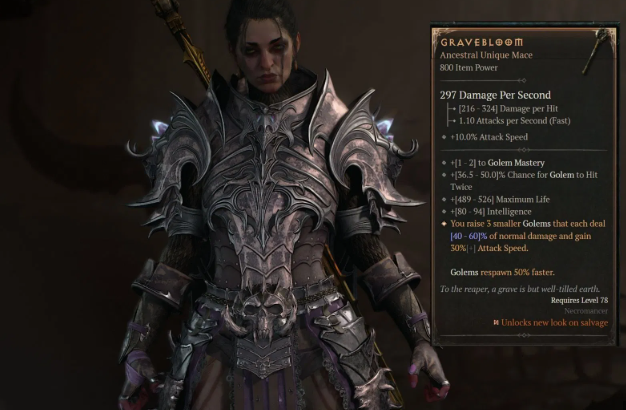
One of the biggest surprises of Season 11, the Golem Necromancer has quickly emerged as a meta-defining build. Unlike traditional minion setups, this build sacrifices Skeleton Warriors and Frost Mages to dramatically amplify Golem damage and utility.

The core of the build revolves around the Gravebloom Unique, which transforms a single Golem into three smaller, faster Golems, massively increasing crowd control and area damage. Supporting Uniques such as Blood Moon Breeches and the optional Godslayer Crown further push the build into S-Tier territory.

Gameplay Rotation:

1. Trap enemies using Corpse Tendrils and Bone Prison

2. Activate Soulrift to maintain buffs and Essence generation

3. Let your Golems overwhelm enemies with relentless damage

While single-target boss damage can lag slightly compared to other Necromancer builds, Golem Necromancer absolutely dominates dense enemy packs. Players looking to gear up quickly often rely on crafting or upgrading key Diablo 4 Items, or choose to buy Diablo 4 materials to accelerate progression.

2) Blood Wave Necromancer

The Blood Wave Necromancer is a long-standing meta favorite that remains incredibly effective in Season 11. This build blends Blood and Shadow damage, unleashing massive waves of AoE destruction while maintaining strong survivability through Blood Mist and Corpse-based mechanics.

Essential Uniques include Kessime’s Legacy and the Fastblood Legendary Aspect, both of which enhance damage uptime and reduce cooldowns. Unlike minion builds, Blood Wave sacrifices all summons, focusing entirely on spellcasting and Overpower scaling.

Gameplay Rotation:

1. Cast Blood Wave on grouped enemies

2. Use Corpse Explosion to generate corpses and amplify damage

3. Carefully activate Blood Mist, managing Rathma’s Vigor stacks

Proper management of Rathma’s Vigor is critical, as mistimed Overpower procs can severely reduce damage output. When played correctly, Blood Wave Necromancer excels in Helltides, dungeon farming, and Pit pushing, especially when paired with optimized Diablo 4 Items or when players choose to buy Diablo IV Items to round out missing gear slots.

3) Shadowblight Necromancer

The Shadowblight Necromancer stands out as one of the most accessible S-Tier builds in Season 11. Its biggest advantage is that it does not require specific Uniques to function at a high level, making it ideal for players early in endgame progression.

That said, Uniques such as Blood Moon Breeches and Godslayer Crown, along with the Cursed Aura Legendary Aspect, significantly enhance the build’s performance.

Gameplay Rotation:

1. Activate Soulrift to establish buffs

2. Use Reap to generate corpses

3. Pull enemies together with Corpse Tendrils

4. Cast Blight and Corpse Explosion to stack Shadowblight

Against bosses, Supernatural Sever is used to generate the first corpse quickly. Shadowblight Necromancer shines in group content, Nightmare Dungeons, and sustained fights, offering excellent damage with relatively low gear requirements.

4) Minion Necromancer

The classic Minion Necromancer remains an S-Tier contender thanks to the overwhelming damage and survivability provided by Skeleton Mages. While slightly squishier than other builds, its straightforward gameplay and sustained DPS make it a favorite among both new and veteran players.

Key Uniques include Hand of Naz, Ring of Mendeln, and Blood Moon Breeches, all of which significantly boost minion damage and durability.

Gameplay Rotation:

1. Cast Blight to increase enemy damage taken

2. Use Corpse Tendrils to group enemies

3. Maintain buffs with Raise Skeleton

4. Activate Soulrift to sustain Essence and cooldowns

Although boss fights can become more difficult if minions die frequently, the build excels in long encounters and large dungeon clears, making it one of the most reliable Necromancer setups in Season 11.

Why These Necromancer Builds Are S-Tier

These four builds-Golem, Blood Wave, Shadowblight, and Minion Necromancer-earn their S-Tier ranking due to several shared strengths:

·Endgame viability: Strong performance in Nightmare Dungeons, Helltides, and The Pit

·Scalability: Effective in both solo and group play

·Accessibility: Achievable through smart farming, optimized Diablo 4 Items, or choosing to buy Diablo 4 materials to speed up gearing

·Engaging gameplay: Each build offers a distinct and satisfying playstyle

Optimizing Your Necromancer in Season 11

To maximize any S-Tier Necromancer build, focus on:

·Acquiring core Uniques like Gravebloom, Hand of Naz, and Kessime’s Legacy

·Optimizing Legendary Aspects such as Fastblood, Cursed Aura, and Blood Mist

·Investing in Paragon Boards and Rune combinations that improve cooldown reduction, damage scaling, and survivability

·Testing builds in group content using Party Finder, where Necromancers truly shine

Conclusion

Despite Paladins dominating Diablo 4 Season 11, Necromancers remain a powerhouse class with multiple S-Tier builds capable of clearing the toughest endgame content. Whether you prefer commanding devastating Golems, unleashing Blood Waves, stacking Shadowblight, or overwhelming enemies with minions, there’s a Necromancer build perfectly suited to your playstyle.

Diablo 4 Season 10: Infernal Chaos Brings Bartuc, Chaos Armor, and Game-Changing Perks

On September 23, 2025, the veil between Sanctuary and the Burning Hells thins once more as Diablo 4 launches Season 10: Season of Infernal Chaos. This ominous new chapter introduces Chaos Armor, unpredictable Chaos Perks, and the return of Bartuc, the Lord of Chaos. Players will descend into reimagined Infernal Hordes, face the deadly Fell Council, and test their strength against one of Sanctuary’s most legendary warlords.

If you’re preparing for the new season, here’s a full breakdown of what to expect-and why stocking up on the right Diablo 4 Items could make all the difference.

A Dark Seasonal Questline: The Sands of Chaos

Every season of Diablo 4 adds a fresh storyline, and Infernal Chaos promises one of the darkest yet. The seasonal narrative begins in Ked Bardu, where players encounter Shyan, an assassin of the Viz-Jaq’taar-an ancient order devoted to hunting mage-corrupted demons.

The Viz-Jaq’taar trace outbreaks of Chaos Rifts to the scheming Fell Council, who are tapping into Mephisto’s lingering corruption to destabilize Sanctuary. As the story unfolds, players will:

·Hunt demonic clues across desert ruins and forgotten sanctuaries.

·Seal destructive Chaos Rifts that threaten to consume the land.

·Prepare for a final confrontation with Bartuc the Bloody, Lord of Chaos.

This questline draws heavily on the Mage Clan Wars, one of the most pivotal moments in Diablo lore. For long-time fans, it is both a nostalgic return and a lore-deepening chapter that sets up Mephisto’s growing role in the Eternal Conflict.

Infernal Hordes Reborn with Chaos Waves

The popular Infernal Hordes activity returns with a massive redesign. Instead of predictable encounters, players will now battle through Chaos Waves, randomized combat trials that bend the rules of traditional wave-based challenges.

Expect:

·Chaos Offerings that alter waves into chaotic, high-stakes events.

·Encounters with erratic Aether Goblins that behave unpredictably.

·Dangerous hazards like projectiles launched from active Chaos Rifts.

·Mini-boss encounters with Hellwyrms, testing both skill and strategy.

The stakes are high, but so are the rewards-survival yields larger stacks of Aether and other valuable loot.

For newer players, Blizzard has also introduced Fleeting Hordes streamlined version, featuring just four waves and a finale against two Fell Council members. This mode offers a smoother introduction before tackling the full chaos of Infernal Hordes.

The Fell Council Returns

Fans of Diablo II will recognize the return of the Fell Council, sorcerers infamous for their devastating powers. In Season 10, one member steps forward each time as the Council Speaker, wielding unique abilities to make every encounter distinct.

These battles are more than nostalgic callbacks-they’re tied to progression and critical loot, especially Chaos Armor. Veterans will need to plan carefully, as ignoring mechanics or rushing in recklessly could end a run prematurely.

Bartuc, Lord of Chaos – The New Seasonal Boss

The headline villain of Season 10 is none other than Bartuc the Bloody, the infamous Vizjerei warlord whose lust for power plunged Sanctuary into chaos during the Mage Clan Wars. Corrupted by demonic influence, Bartuc now stands as the ultimate boss of the season.

His fight is as cinematic as it is brutal:

·Chaos Portals flood the arena with projectiles and summoned demons.

·Teleport pads allow clever repositioning for counterattacks.

·His invulnerability shield triggers only after 10 seconds, guaranteeing action begins immediately.

Bartuc isn’t just another boss-he’s the key to unlocking Season 10’s most important loot. Defeating him on Torment III or IV guarantees drops of Chaos Armor, making him a must-farm target for serious players.

Chaos Armor: Build-Defining Loot

The biggest gameplay innovation of Season 10 is Chaos Armor, a radical twist on Unique Diablo 4 Items. These items don’t just improve stats-they redefine builds.

What sets them apart:

·Slot-shifting loot: A Unique normally found in one slot may drop in another.

·Always-maximized aspects: No need to reroll for perfect rolls.

·At least one Greater Affix, ensuring strong endgame viability.

For example, Fists of Fate, traditionally a glove Unique, might drop as a helm in Chaos Armor form. That means you could wear both Fists of Fate and another Unique glove simultaneously, unlocking new, powerful synergies.

Chaos Armor primarily drops from Bartuc, with higher Torment tiers offering the best odds. For min-maxers and theorycrafters, this system opens up endless new possibilities.

Chaos Rifts and Rift-Infused Dungeons

Scattered across Sanctuary, Chaos Rifts represent the raw corruption of the Burning Hells spilling into the mortal realm. They appear during Helltide events and inside Nightmare Dungeons, transforming ordinary content into high-stakes challenges.

Why Chaos Rifts matter:

·Closing them grants seasonal reputation, loot, and experience.

·Rare Mythical Chaos Rifts can spawn in higher Torments, dropping the best gear of the season.

·Rift-infused Nightmare Dungeons reward Fleeting Horde Compasses, adding variety to farming loops.

For efficient farming, having the right loadout is key. Many players choose to buy Diablo IV Items or stockpile cheap Diablo 4 materials ahead of time to ensure smooth Rift clears and maximize loot per hour.

Why Season of Infernal Chaos Matters

Blizzard has experimented with unique mechanics in past seasons, but Infernal Chaos feels like the most ambitious update yet.

·For lore fans: It expands on the Mage Clan Wars, giving more depth to the Viz-Jaq’taar and setting up Mephisto’s rising role.

·For min-maxers: Chaos Armor revolutionizes gearing and introduces endless build diversity.

·For endgame grinders: Chaos Waves and Rift-infused dungeons provide challenging, loot-rich activities.

·For casual players: Fleeting Hordes and Chaos Rifts make seasonal content approachable without sacrificing rewards.

The combination of nostalgia (the Fell Council), innovation (Chaos Armor), and high-stakes combat (Bartuc) makes this one of the most defining Diablo 4 seasons to date.

Final Thoughts

The Season of Infernal Chaos launches September 23, 2025, and promises to reshape how players approach Diablo 4. With Bartuc commanding the battlefield, the Fell Council scheming in the shadows, and Chaos Armor unlocking new builds, this is a season no player will want to miss.

Now is the time to prepare your builds, refine strategies for Infernal Hordes, and gather the right Diablo 4 Items to give yourself every possible advantage. Chaos is coming-will you rise to meet it?